Private Foundations (501(c)(3))
Capital Allocation Infrastructure for Long-Term Public Benefit
Private foundations are federally recognized, tax-exempt entities designed to allocate capital for charitable, educational, scientific, and humanitarian purposes. They serve as the primary mechanism through which excess income, assets, and investment capital are governed, deployed, and recycled for long-term impact within the U.S. tax-exempt system.
Role Within the U.S. Philanthropic Framework
In the United States, private foundations:
Are typically funded by individuals, families, corporations, or institutions
Are required to distribute a minimum of 5% of assets annually
Operate under strict self-dealing, reporting, and governance rules
May engage in grantmaking and program-related investments
Private foundations are not discretionary vehicles.
They are regulated capital-deployment structures.
Strategic Function of Private Foundations
When properly designed, private foundations function as:
Long-term capital allocation vehicles
Charitable investment and grantmaking platforms
Legacy and continuity structures
Institutional funding partners for public nonprofits
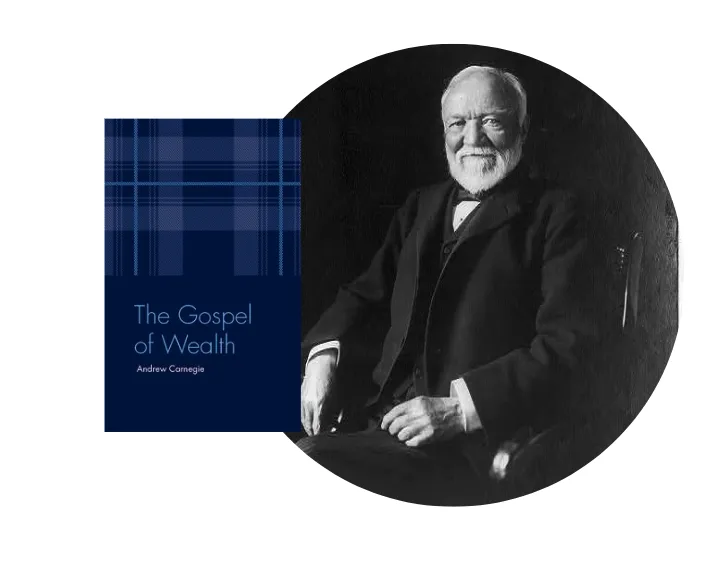
The modern private foundation framework in the United States emerged from early industrial-era debates on capital stewardship, governance, and public benefit.
Role Within the Matching Framework
Within the Become a Philanthropist framework, private foundations function as capital sources.
The Institute provides structural coordination to support lawful, mission-aligned deployment of foundation capital, including:
Compliance-first foundation formation and operational alignment
Strategic matching between foundations and qualified public nonprofits
Grantmaking frameworks aligned with mission, geography, and public-benefit objectives
Alignment of legal, tax, banking, investment, and fiduciary strategies, concepts, and professionals
Planning support for exits, liquidations, assignments, bequests, and intellectual property transfers
Governance continuity, including multi-generational board succession
Stewardship guidance for trustees and foundation leadership
The Institute does not acquire ownership, equity, or control over foundation assets, investments, or grantmaking decisions.
Structural Integrity & Compliance
Private foundations operate within a defined statutory and regulatory framework and are subject to heightened oversight, including:
Prohibition of self-dealing and private inurement
Annual charitable distribution requirements
Excise tax on net investment income
Ongoing reporting and public disclosure obligations
Proper design, governance, and administration are essential to ensure compliance, preserve institutional credibility, and avoid regulatory or reputational exposure.
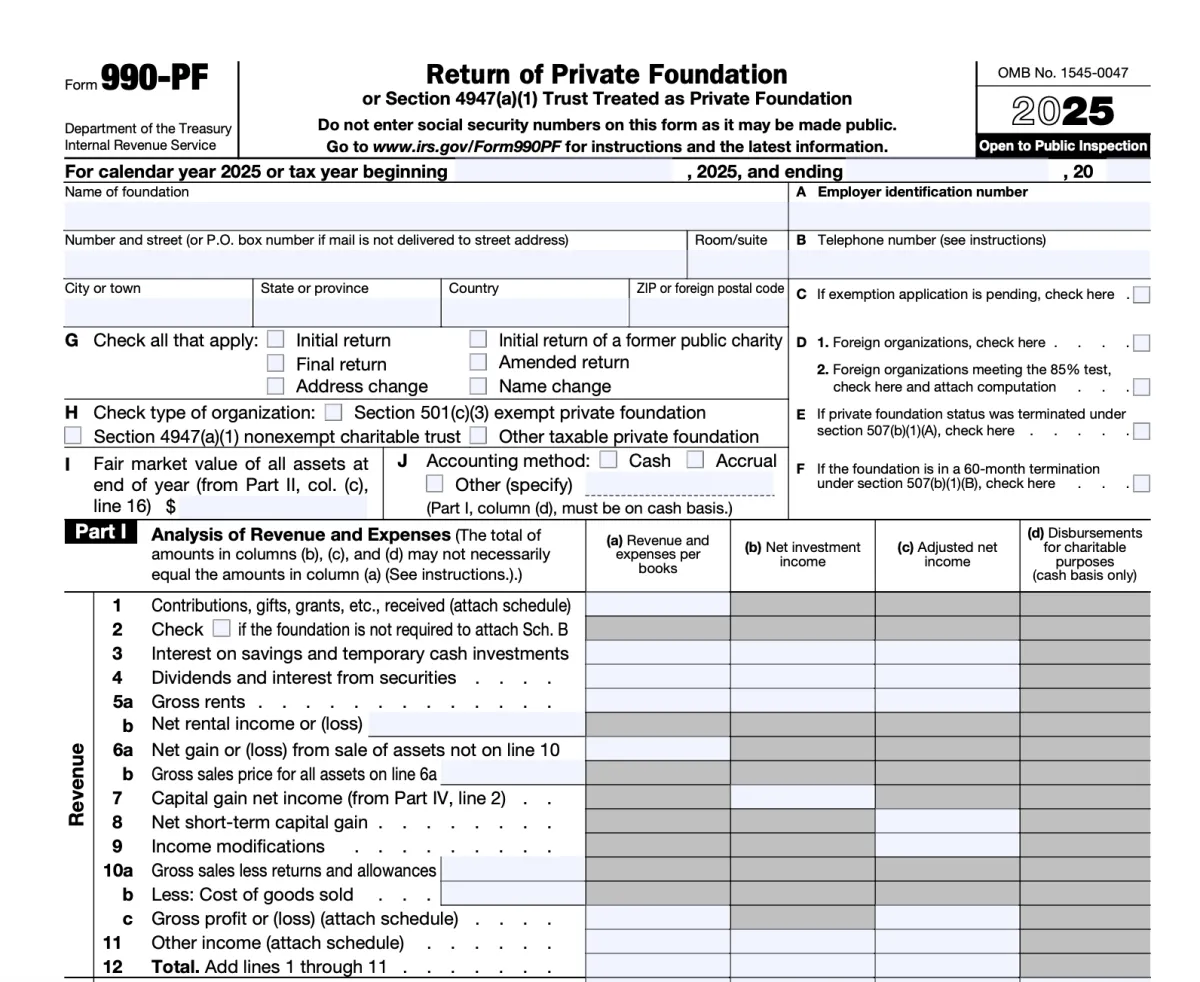
Illustrative excerpt from IRS Form 990-PF (Return of Private Foundation), demonstrating required public reporting and disclosure obligations.
Integration With Broader Planning
Private foundations are most effective when coordinated with broader legal and financial structures, including:
Business entity structures
Intellectual property ownership
Investment strategies
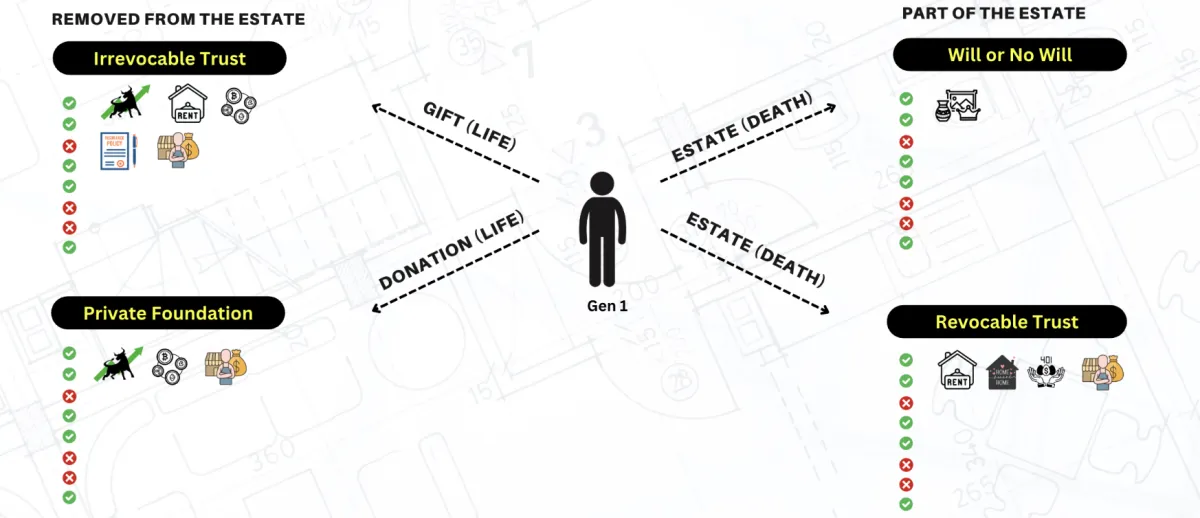
Estate and succession planning
Family governance frameworks
This coordination promotes consistency across legal, tax, financial, and philanthropic decision-making and reduces fragmentation across entities and generations.
When Exploration Is Appropriate
Exploration of a private foundation structure may be appropriate for:
Individuals or families with sustained excess income or assets
Families training the next generation of leaders
Business owners approaching liquidity or exit events
Corporations with ongoing charitable deployment obligations
Institutions seeking long-term philanthropic governance
Investors exploring alternative liquidation strategies
Participation begins with an application and eligibility review.
Explore Participation
If you are evaluating the role of a private foundation within a broader philanthropic or capital-allocation strategy, you may apply to explore participation through the Institute.
FOLLOW US


COMPANY
LEGAL
Copyright © 2025. Nonprofits And Foundations c/o Estate Law Training Center. All Rights Reserved.